
This article introduces selected principles from Changing Probabilities, the forthcoming book project by Panagiotis Pomonis, exploring goalkeeping beyond technique — through perception, positioning, communication, decision-making and the human being behind the action.
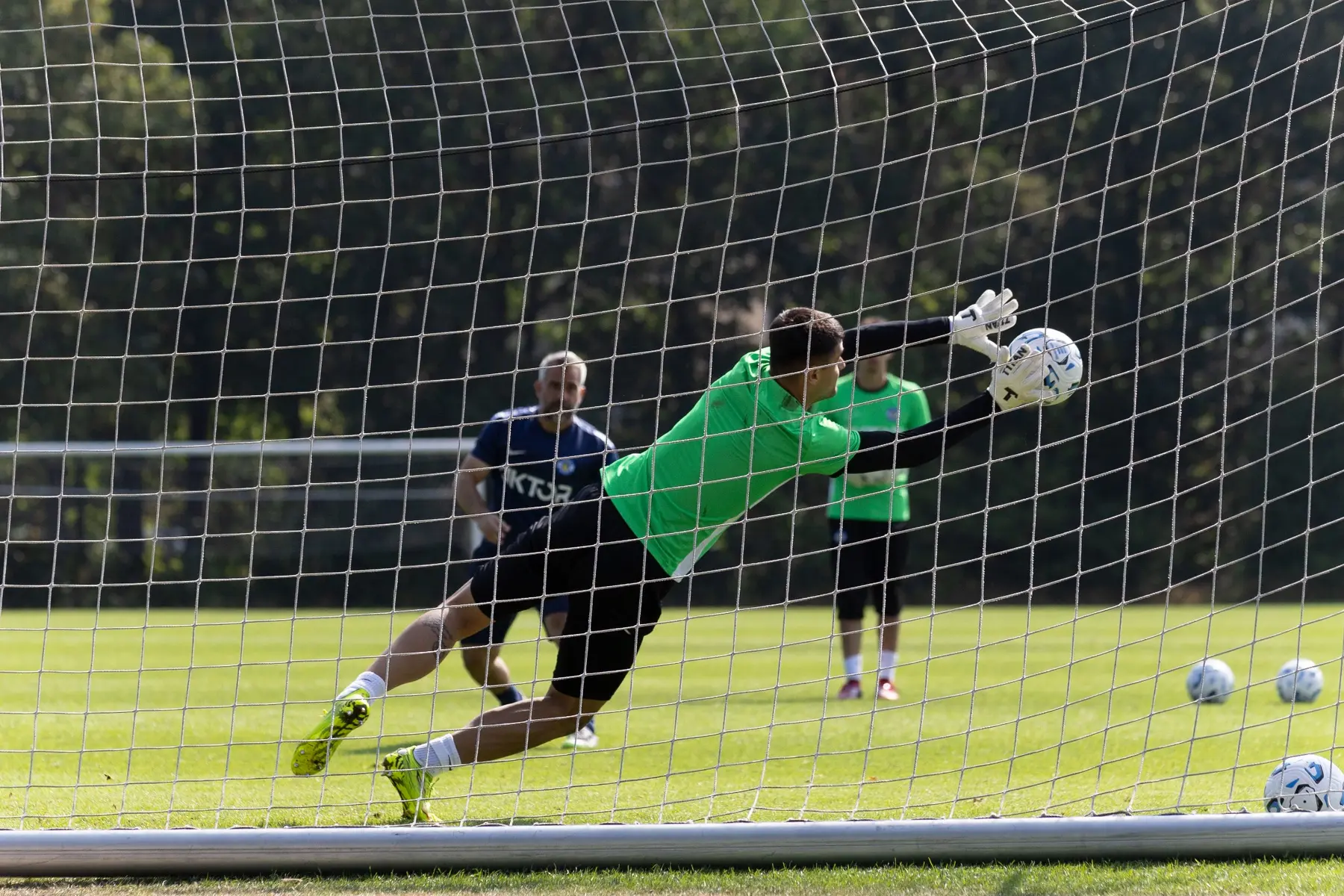
When a goalkeeper makes a save, our attention almost always goes to the final action.
- The hands.
- The dive.
- The speed of the reaction.
- The technical execution.
This is the most spectacular part of the moment. But it is only the final and most visible part.
The save does not begin when the ball leaves the opponent’s foot. It begins earlier: in the information the goalkeeper has recognised, the position he has chosen, the space he has controlled, the timely communication he has provided and the decision that has already begun to take shape.
Technique remains essential. But technique does not operate alone. For it to be executed at the right moment, a process of understanding must come first.
This is exactly what happens before the save.
The Last Visible Moment
In football, we tend to evaluate the goalkeeper through the outcome.
- If he makes the save, we assume that he acted correctly.
- If he concedes, we immediately look for what he could have done differently.
The reality, however, is more complex.
A goalkeeper can follow a sound process and the phase may still end in a goal. He can also follow a process that requires improvement and still be rescued by his athletic ability or by a poor execution from the opponent.
That is why the outcome cannot be the only criterion for evaluation.
To understand the action properly, we need to go back and examine the process that produced it.
What had the goalkeeper perceived?
What did he see, and what did he judge?
Where was he positioned?
What did he identify as the immediate threat: the player, the space or the relationship between them?
How was his position connected to the ball, the space, the opponent and his teammates?
When did he recognise that the situation was changing?
And ultimately, what information shaped his decision?
How did he manage the risk and influence the probabilities?
The save is the result of this sequence. It is not an isolated movement.
The Goalkeeper Acts Before the Problem Is Created
The modern goalkeeper does not simply wait for the final shot and then react.
He follows the development of the phase and continually tries to move one step closer to what may happen next. He cannot know with certainty what will happen. No one can. But he can recognise the probabilities and prepare accordingly.
Consider an attack developing from a wide area.
Before the final pass is even played, the goalkeeper observes the position of the ball, the opponent’s body shape, the movements inside the penalty area, the pressure applied by his teammates and the spaces beginning to open.
Within a few seconds, he may need to prepare for several possible outcomes:
- A cross.
- A through pass.
- A cut-back.
- An individual action.
- Or an immediate finish.
His task is not to guess. It is to read the phase in a way that allows his position and behaviour to keep as many effective responses available as possible.
The Four References of the Decision
Within the Changing Probabilities framework, reading the game is built around four fundamental and continuously connected references:
The Ball
The position of the ball is the first reference.
The goalkeeper must recognise the channel and the third of the pitch in which the ball is located, as well as its speed, direction, the quality of the opponent’s control and the ball’s relationship to the next possible action.
An open ball creates different possibilities from a closed ball. A quickly moving ball reduces the available time. A poor first touch can create an opportunity to intervene that did not previously exist.
The ball provides information. The goalkeeper must be able to recognise it early enough.
Space
Space is not fixed. It changes with every movement.
The goalkeeper observes the space in front of him, behind the defensive line, around the opponent and inside the penalty area. At the same time, he must perceive the space that is about to emerge.
He does not react only to what is already open. He tries to recognise what is likely to open in the next moment.
Effective positioning is not only about where he stands. It is primarily about the possibilities that a particular position allows him to preserve.
The Opponent
The opponent’s body reveals intentions without ever providing absolute certainty.
Body shape and angle, the supporting foot, the quality of the first touch, the speed of approach and the available options all provide information.
The goalkeeper does not observe only the player in possession. He also recognises the movements of the other opponents and the relationships they create between them.
The objective is not to predict the opponent’s decision with certainty. It is to reduce the degree of uncertainty.
Teammates
The goalkeeper does not face the phase alone.
The position, pressure, cover and orientation of his teammates directly affect his options. A defender who applies pressure to the ball effectively can restrict particular passes and angles of threat. Delayed cover can create new space. Timely and targeted communication can change the behaviour of the entire defensive line.
The goalkeeper is part of the collective function. He does not operate outside the team model.
He sees, judges, informs and influences.
From Information to Action
The four references do not function as a checklist that the goalkeeper reviews mechanically.
They are connected through a continuous process:
Perception
First, he must recognise what is happening and what may follow.
The earlier he identifies a change in the phase, the more time he creates for his next actions.
Positioning and Repositioning
His position must continually adapt to new information.
There is no single correct position independent of the phase. There is only the position that best serves the demands of the specific situation and the way the team operates.
Communication
Information becomes more valuable when it can also influence teammates.
Communication must be timely, targeted and clear. It is not simply a voice. It is an intervention in the collective decision.
Decision
At some point, the goalkeeper must commit to an option.
- Stay or move.
- Attack the space or protect the goal.
- Hold, parry or redirect the ball.
- Reduce the distance or preserve reaction time.
Every decision has a cost, and every option leaves something else less protected. The quality of the decision lies in managing this balance.
Action
Only then does the technical execution appear.
Technique gives form to the decision. But its quality is influenced by everything that has come before it.
A better reading of the game can create a better position. A better position can increase the available time. And more time can allow for a cleaner and more effective technical action.
A Good Decision Does Not Guarantee the Outcome
Decision-making in football always takes place under uncertainty.
The goalkeeper manages changing information, opponents trying to deceive him and time windows that often disappear.
That is why a good decision cannot guarantee success. It can, however, increase the probability of a positive outcome.
This also changes the way we should evaluate the goalkeeper.
We do not examine only whether he made the save. We examine whether his process was functional and whether his decision responded to the information available to him at that specific moment.
Evaluation should not be based on the knowledge we gained after the phase was completed. It must try to return to the moment of the decision.
What could he genuinely see at that moment?
What did he know?
How much time did he have?
Which options were available?
This distinction is fundamental to the meaningful development of the goalkeeper.
What This Means for Training
If we want to develop better goalkeepers, it is not enough to repeat only the final technical action.
Training must create situations in which the goalkeeper:
- recognises information,
- observes changes in space and time,
- connects with teammates,
- communicates,
- evaluates risk and probabilities and selects between different functional responses,
- executes under spatial and temporal pressure,
- and then reviews his process.
The exercise is not the final destination. It is the means through which better perception, clearer judgement, a more functional decision and more effective behaviour are transferred into the game.
We do not train movements alone. We train the goalkeeper’s ability to understand when, why and how to use them.
The Human Being Behind the Decision
The goalkeeper’s decision is not only technical or tactical.
It is also human.
It is made under pressure, with limited time and with the knowledge that the outcome may shape the way his entire performance is interpreted.
The goalkeeper must remain functional after a difficult moment. He must not carry the previous phase into the next one. He must continue to communicate, decide and take responsibility.
Emotional stability is not outside performance. It is part of it.
When we develop the goalkeeper, we are not developing only the body that executes the action. We are developing the human being who perceives, decides and must live with the outcome.
Changing the Probabilities
The goalkeeper cannot control everything.
But he can significantly influence what is about to happen.
- With timely information, he can change a teammate’s position.
- With better positioning, he can restrict the opponent’s options.
- With a clear decision, he can increase time or reduce the available space.
- With a functional action, he can change the development of the phase.
This is the meaning of Changing Probabilities.
The goalkeeper does not simply wait for the game to reach him. He participates in shaping its conditions.
The save remains important. But it is only the last visible moment of a much larger process.
And if we truly want to understand, train and evaluate the goalkeeper, we must learn to see everything that happened before it.
Changing Probabilities develops this framework in greater depth, connecting the goalkeeper’s perception, decisions, actions and human experience.