
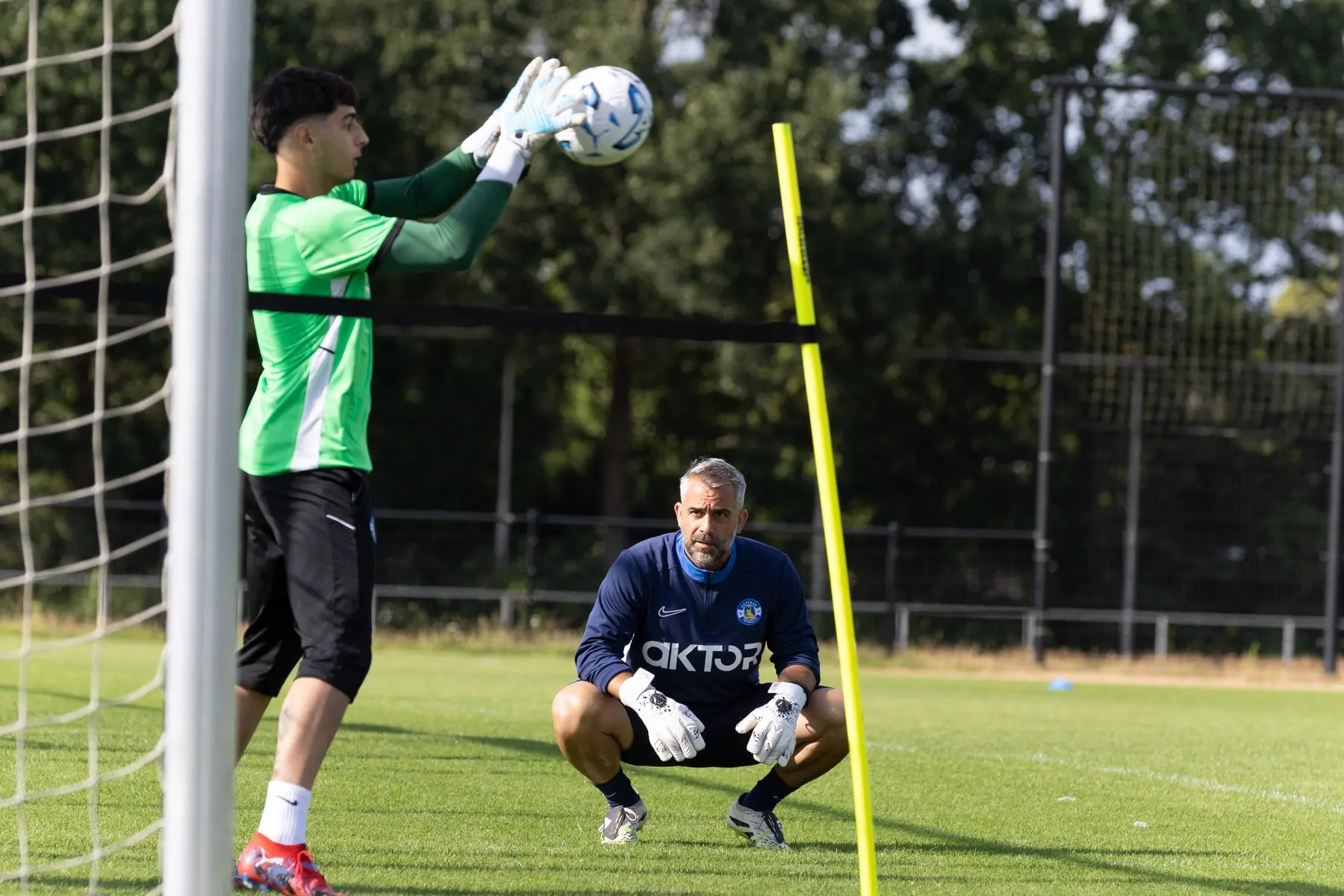
This article explores how motor learning can develop a goalkeeper’s movement foundation, adaptability and ability to transfer training into the game. It is part of Changing Probabilities, the forthcoming book project by Panagiotis Pomonis.
A goalkeeper can execute a technically clean dive in training. The starting position is familiar. The delivery is predictable. The body is balanced, and the movement is repeated with consistency.
- Same movement.
- Same solution.
- Again and again.
Then the game changes the problem. The goalkeeper is moving when the shot arrives. His balance is different. A defender restricts his view. The ball is deflected. The space and available time are no longer the same.
The technical ability has not disappeared. But can the goalkeeper use it under these new conditions?
It is not enough for a goalkeeper to be able to execute a movement. What matters is whether he can use it when the game actually demands it.
A Movement Foundation That Must Be Cultivated
Motor learning concerns the acquisition, improvement and retention of movement skills through practice and experience. For goalkeeper development, I see its greatest value in building a movement foundation that is broad enough to support different responses.
I think of this foundation as a field that needs to be cultivated. Balance, coordination, stability, acceleration, deceleration, changes of direction and body control are not isolated achievements. Cultivating these qualities gives the goalkeeper more functional movement options as conditions change.
Strength, speed and power remain essential. Yet their value is not measured only by what the athlete can demonstrate in a controlled test. It is also measured by how effectively he can express those qualities when his position, balance, timing and available information change.
The aim is not to create a goalkeeper with a collection of perfectly reproduced movements. It is to develop a goalkeeper who can organise an effective response to the situation in front of him.
Repetition Has a Purpose. It Is Not the Destination.
I do not reject repetition or stable practice conditions. They can be valuable when a goalkeeper is learning a new movement, improving body control or refining a technical detail.
But if the conditions never change, consistent performance can give us an incomplete picture of the player’s development.
The next step is to introduce variability with a purpose: different starting positions, distances, ball trajectories, visual information and time constraints. As the goalkeeper becomes more capable, the training environment should ask him not only to execute, but also to recognise when and how an action is appropriate.
More complexity does not automatically mean better learning. Every change in the demands of an exercise must serve a specific coaching purpose.
A good exercise is not defined by how difficult it looks. It is defined by the quality of the learning opportunity it creates and its relevance to the game.
Movement and Information Develop Together
The goalkeeper does not move independently of what he sees. The opponent’s body shape, the ball’s position, the space around the attacker and the movement of teammates can all influence his behaviour.
Consider an attacker driving diagonally towards goal. The goalkeeper adjusts his position. As he moves, the angle and distance change. The attacker’s next touch introduces new information. The goalkeeper may need to slow down, regain balance or prepare for a different action.
This is why perception and action should not be understood as two completely separate stages. They influence one another while the situation develops.
Training should help the goalkeeper recognise meaningful information and connect it to movement. It should not simply reward a rehearsed response to a signal whose meaning has no relationship to the game.
From a Technical Solution to an Adaptable Response
In practice, I work from a simple question: what does the goalkeeper need to become better at managing?
If the objective is a low save, I may initially focus on the movement and its execution. Then I can change the starting position or the direction from which the ball arrives. Later, I can include an opponent, a defender or a realistic decision between holding position and attacking the ball.
These are not three rigid stages that every goalkeeper must follow in the same way. They are ways of adjusting the challenge to the player’s level, the purpose of the session and the information he needs to use.
The objective is not to expose the goalkeeper to chaos for the sake of it. The objective is to prepare him to remain functional when the game no longer presents the exact situation he rehearsed.
Training Performance Is Not the Same as Learning
A goalkeeper can perform exceptionally well in one training session without necessarily demonstrating lasting learning.
To understand development more accurately, we also need to consider retention and transfer. Can the goalkeeper reproduce the ability after time has passed? Can he adapt it when the conditions are different? And does it become useful in match situations?
The answers are not always visible during the exercise itself. They emerge through observation across sessions and through the way the player responds to new game-relevant cues and demands.
That is why I want to see how the goalkeeper’s judgement develops over time and how it is reflected in his decisions and actions, not only how he performs in an individual training session.
Video Analysis as Part of the Learning Process
Video analysis can support this process, provided we use it to understand behaviour rather than simply judge the outcome.
I use Perception — Decision Making — Action as a practical analysis framework: See — Assess — Act. It helps me examine the situation beyond the final technical execution.
Video cannot tell us with certainty everything the player perceived or thought. That is why I use guided discovery. Instead of immediately providing the answer, I ask the goalkeeper what he saw, how he assessed the immediate danger, what he judged the situation required and how he acted. We then examine which other functional options may have been available in a similar situation.
The conversation becomes part of the goalkeeper’s learning and development. The purpose is not only to improve the next action, but to develop his capacity to assess and manage the next game situation.
The Person Behind the Movement
Learning also requires the goalkeeper to experience uncertainty, make decisions and encounter actions that require improvement. These moments should provide information for development, not become labels attached to the player.
A coach must be demanding about the action while remaining clear about the difference between an action and the person who performed it.
We are developing an athlete who must act under pressure, accept responsibility and continue after the moment has passed. Movement development and human development cannot be treated as entirely separate responsibilities.
Changing the Probabilities
We cannot prepare a goalkeeper for every possible ball, opponent or match situation. Nor can we remove uncertainty from the game.
We can cultivate a broader movement foundation, connect it to relevant information and create training environments in which the goalkeeper learns to find functional solutions under changing demands.
Changing Probabilities does not mean controlling every outcome. It means developing the qualities that allow the goalkeeper to manage situations more effectively and, where possible, influence the probabilities in his favour.
The real value of training is not simply the movement a goalkeeper repeats today. It is the solution he can find tomorrow, when the game presents something different.
Changing Probabilities explores goalkeeper development beyond technical execution, connecting movement, perception, decision-making, learning and the human being behind the action.